While no car can prevent all accidents, we work every day to make them less likely to occur. The massive amount of real-world data gathered from our cars’ eight cameras, 12 ultrasonic sensors, and forward-facing radar, coupled with billions of miles of inputs from real drivers, helps us better understand the patterns to watch out for in the moments before a crash.
As our quarterly safety reports have shown, drivers using Autopilot register fewer accidents per mile than those driving without it. That’s because Autopilot is designed to reduce fatigue by helping drivers stay in their lane, while also ensuring that they keep their hands on the wheel. While lane-keeping and hands-on monitoring can be extremely effective at helping to reduce the likelihood of an accident when Autopilot is in use, we believe that these precautions can also be extremely effective for preventing accidents when Autopilot is not in use.
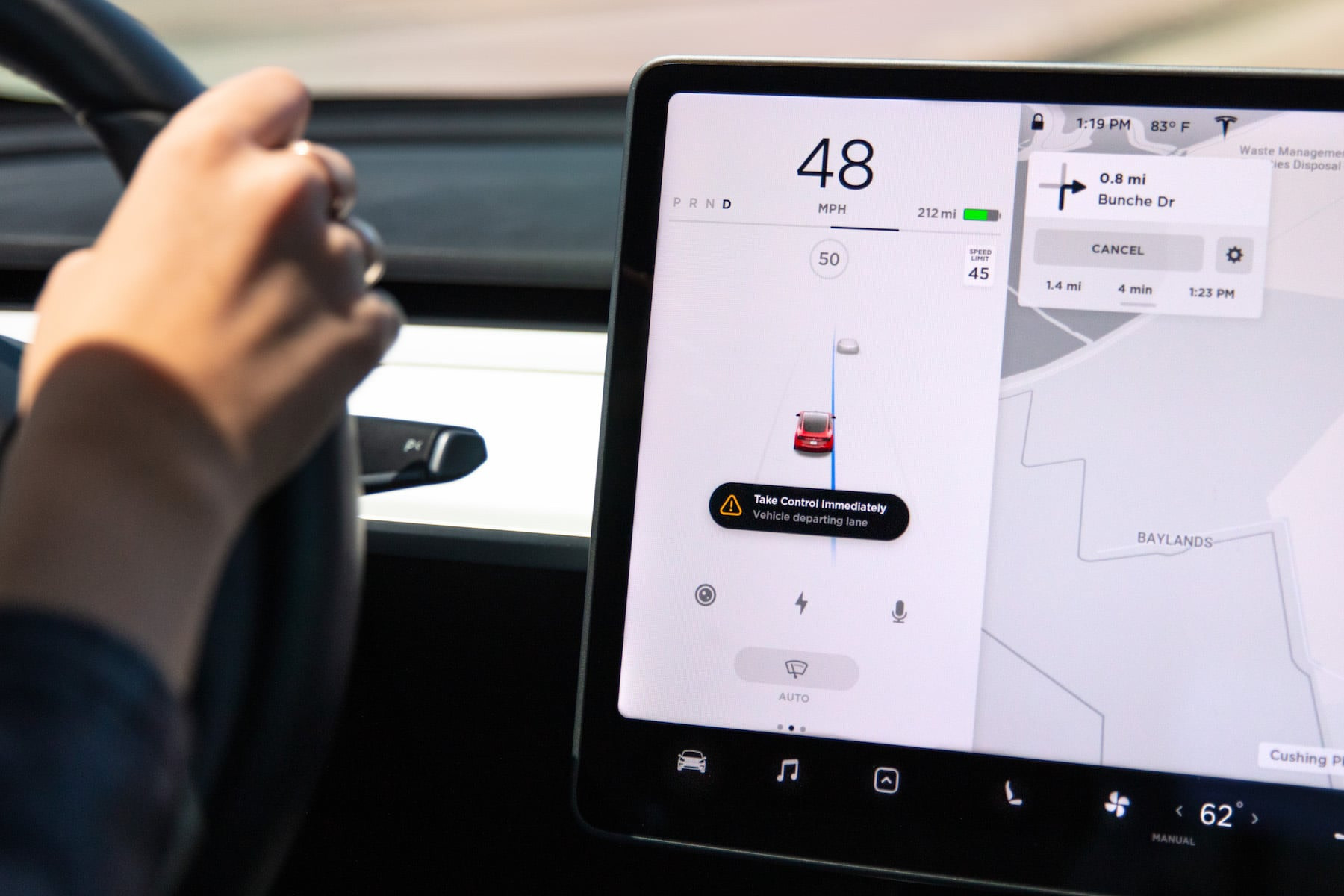
Today, we’re introducing two new safety features designed to help prevent drivers from inadvertently departing their lane, which our data shows is a common cause of accidents when Autopilot is not in use. These new features – Lane Departure Avoidance and Emergency Lane Departure Avoidance – help drivers stay engaged and in their lane in order to avoid collisions.
Lane Departure Avoidance Lane Departure Avoidance lets a driver elect to have corrective steering applied in order to keep them in their intended lane. When the feature is in use and a driver is departing a lane without their turn signal on, the car will also check to see whether a driver’s hands are on the wheel. If a driver’s hands are not detected on the wheel, the driver will receive a series of hands-on reminders and alerts, similar to the ones that our cars provide to customers who use Autopilot. If a driver’s hands are repeatedly not detected on the wheel when Traffic Aware Cruise Control is in use, their car will gradually slow down to 15 miles below the speed limit or below the car’s set speed and turn its hazard lights on.
This feature can be turned on or off, and works at speeds between 25 and 90 mph. It is an extension of Lane Departure Warning, which already warns drivers through a steering wheel vibration if they begin to drift out of their lane without their turn signal engaged.
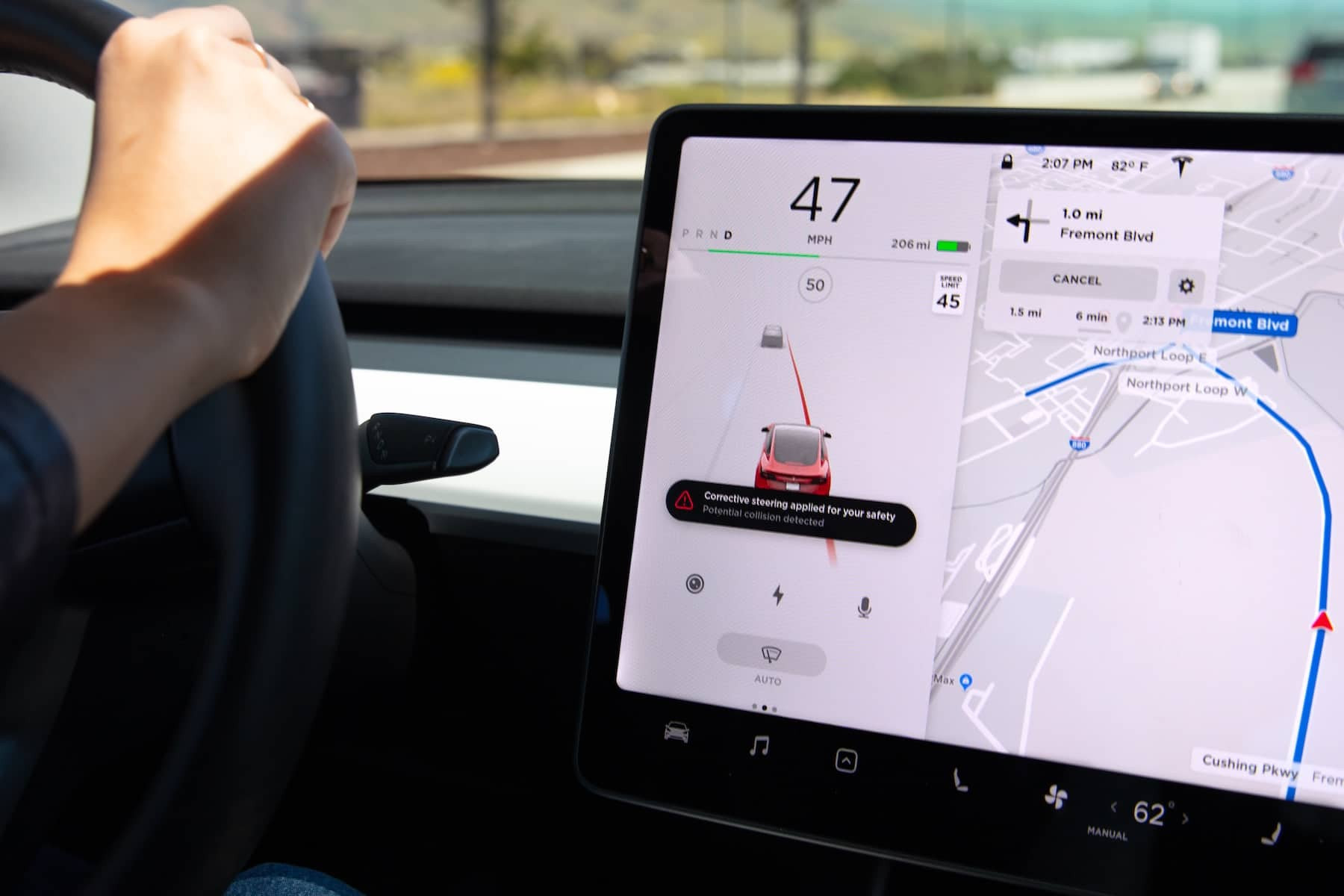
Emergency Lane Departure Avoidance Emergency Lane Departure Avoidance is designed to steer a Tesla vehicle back into the driving lane if our system detects that it is departing its lane and there could be a collision, or if the car is close to the edge of the road. This feature will automatically be enabled at the beginning of every drive, but can be turned off for a single drive by going to the Autopilot Controls menu.
At Tesla, improving safety is our primary goal, even after a customer purchases their car. That’s why we’re introducing these features beginning today via a free over-the-air software update, starting with Model 3 owners and gradually expanding to all cars that were built after October 2016. This is just another way that we are helping to protect Tesla drivers and passengers, and others on the road, every day.
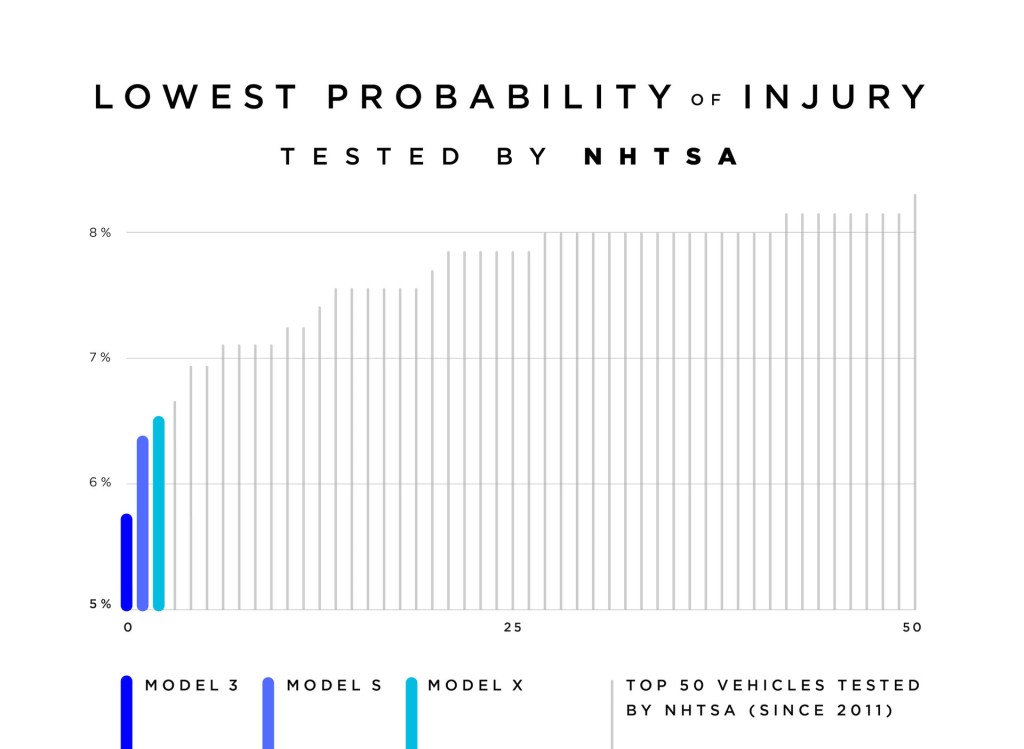
Based on the advanced architecture of Model S and Model X, which were previously found by the National Highway Traffic Safety Administration (NHTSA) to have the lowest and second lowest probabilities of injury of all cars ever tested, we engineered Model 3 to be the safest car ever built. Now, not only has Model 3 achieved a perfect 5-star safety rating in every category and sub-category, but NHTSA’s tests also show that it has the lowest probability of injury of all cars the safety agency has ever tested.
NHTSA tested Model 3 Long Range Rear-Wheel Drive as part of its New Car Assessment Program, a series of crash tests used to calculate the likelihood of serious bodily injury for front, side and rollover crashes. The agency’s data shows that vehicle occupants are less likely to get seriously hurt in these types of crashes when in a Model 3 than in any other car. NHTSA’s previous tests of Model S and Model X still hold the record for the second and third lowest probabilities of injury, making Tesla vehicles the best ever rated by NHTSA. We expect similar results for other Model 3 variants, including our dual-motor vehicles, when they are rated.
What makes Model 3 safe? In addition to its near 50/50 weight distribution, Model 3 was also designed with an extremely low polar moment of inertia, which means that its heaviest components are located closer to the car’s center of gravity. Even though Model 3 has no engine, its performance is similar to what’s described as a “mid-engine car” due to its centered battery pack (the heaviest component of the car) and the fact that Model 3’s rear motor is placed slightly in front of the rear axle rather than behind it. Not only does this architecture add to the overall agility and handling of the car, it also improves the capability of stability control by minimizing rotational kinetic energy.
Like Model S and Model X, Model 3 benefits from its all-electric architecture and powertrain design, which consists of a strong, rigid passenger compartment, fortified battery pack, and overall low center of gravity. These safety fundamentals help to prevent intrusion into the cabin and battery modules, reduce rollover risk, and distribute crash forces systematically away from the cabin – all while providing the foundation for our superior front crumple zone that is optimized to absorb energy and crush more efficiently. Here, you can see how the orange internal combustion engine block is thrust towards the cabin during a frontal impact test:
We also added state of the art features and new innovations in crash structure design, restraints and airbags, and battery safety to the core of Model 3’s design:
In frontal crashes, Model 3’s efficient front crumple zone carefully controls the deceleration of occupants, while its advanced restraint system complements this with pre-tensioners and load-limiters that keep occupants safely in place. Specially designed passenger airbags are shaped to protect an occupant’s head in angled or offset crashes, and active vents dynamically adjust the internal pressure of the frontal airbags to optimize protection based on the unique characteristics of the crash. Front and knee airbags and a collapsible steering column work to further reduce injury, all contributing to Model 3’s 5-star rating in frontal impact.
In pole impact crashes, in which a narrow obstruction impacts the car between the main crash rails, energy-absorbing lateral and diagonal beam structures work to mitigate the impact. This includes a high-strength aluminum bumper beam, a sway bar placed low and forward in the front of the car, cross-members at the front of the steel subframe that are connected to the main crash rails, and additional diagonal beams in the subframe that distribute energy back to the crash rails when they aren’t directly impacted. An ultra-high strength martensitic steel beam is also attached to the top of the front suspension to further absorb crash energy from severe impacts, and the rear part of the subframe is shaped like a “U” and buckles down when impacted. These structures continue to be effective even when a front motor is added for Model 3 Dual-Motor All-Wheel Drive, due to the fact that the subframe is designed to pull the nose of the motor down and out of the way.
Model 3 also has the lowest intrusion from side pole impact of any vehicle tested by NHTSA. Unlike frontal crashes, there is little room for crumple zone in a side impact, so we patented our own pillar structures and side sills to absorb as much energy as possible in a very short distance. These structures work alongside the vehicle’s rigid body and fortified battery architecture to further reduce and prevent compartment intrusion. With less intrusion into the cabin, our side airbags have more space to inflate and cushion the occupants inside.
Rollover accidents are a significant contributor to injuries and deaths on U.S. roads. Tesla’s vehicle architecture is fundamentally designed to have a very low center of gravity, which is accomplished by placing the heavy battery pack and electric motors as close to the ground as possible. In the event that a rollover does occur, our internal tests show that the Model 3 body structure can withstand roof-crush loads equivalent to more than four times its own weight and with very little structural deformation. NHTSA’s standards only require that cars withstand loads of three times their own weight.
Many companies try to build cars that perform well in crash tests, and every car company claims their vehicles are safe. But when a crash happens in real life, these test results show that if you are driving a Tesla, you have the best chance of avoiding serious injury.
Methodology While NHTSA’s New Car Assessment Program doesn’t distinguish safety performance beyond its 5-star scale, every car rated by NHTSA since 2011 is assigned a Vehicle Safety Score, which NHTSA calculates by taking the weighted average of the Relative Risk Scores (RRS) in front, side and rollover crashes. We compared the underlying and publicly-available NHTSA data for each published vehicle since this calculation protocol began in 2011 (dockets: NHTSA-2010-0164, NHTSA-2011-0085, NHTSA-2012-0055, NHTSA-2013-0053, NHTSA-2014-0043, NHTSA-2015-0034, NHTSA-2016-0045, NHTSA-2017-0037).
The Vehicle Safety Score represents the “relative risk of injury with respect to a baseline of 15%,” according to NHTSA. Model 3 achieved a Vehicle Safety Score of 0.38, which is lower than any other vehicle rated in NHTSA’s public documents. By multiplying the Vehicle Safety Score by NHTSA’s 15% baseline figure, we arrived at an overall probability of injury for Model 3 of 5.7%. Applying the same calculation to each of the vehicles rated in NHTSA’s documents, we found that Model S achieved an overall probability of injury of 6.3%, and Model X achieved an overall probability of injury of 6.5%, making them the vehicles with the second and third lowest probabilities of injury, respectively, based on NHTSA’s publicly-available data and records.
We respect that NHTSA only endorses ratings from 1-5 stars so they can be helpful for the public to make quick and easy comparisons. The star ratings are especially helpful to show on the Monroney window stickers of new vehicles that are offered for sale. At the same time, we used NHTSA’s own methodology and data to help further educate the public about important safety information.
Safety is at the core of our design and engineering decisions. In 2021, we began our transition to Tesla Vision by removing radar from Model 3 and Model Y, followed by Model S and Model X in 2022. Today, in most regions around the globe, these vehicles now rely on Tesla Vision, our camera-based Autopilot system.
Since launch, we have continued to make incremental improvements in both feature parity and safety. Compared to radar-equipped vehicles, Model 3 and Model Y with Tesla Vision have either maintained or improved their active safety ratings in the U.S. and Europe, and perform better in pedestrian automatic emergency braking (AEB) intervention.
In 2022 we took the next step in Tesla Vision by removing ultrasonic sensors (USS) from Model 3 and Model Y for most global markets, followed by all Model S and Model X in 2023.
Along with the removal of USS, we simultaneously launched our vision-based occupancy network – currently used in Full Self-Driving (FSD) Beta – to replace the inputs generated by USS. With today’s software, this approach gives Autopilot high-definition spatial positioning, longer range visibility and the ability to identify and differentiate between objects. As with many Tesla features, our occupancy network will continue to improve rapidly over time.
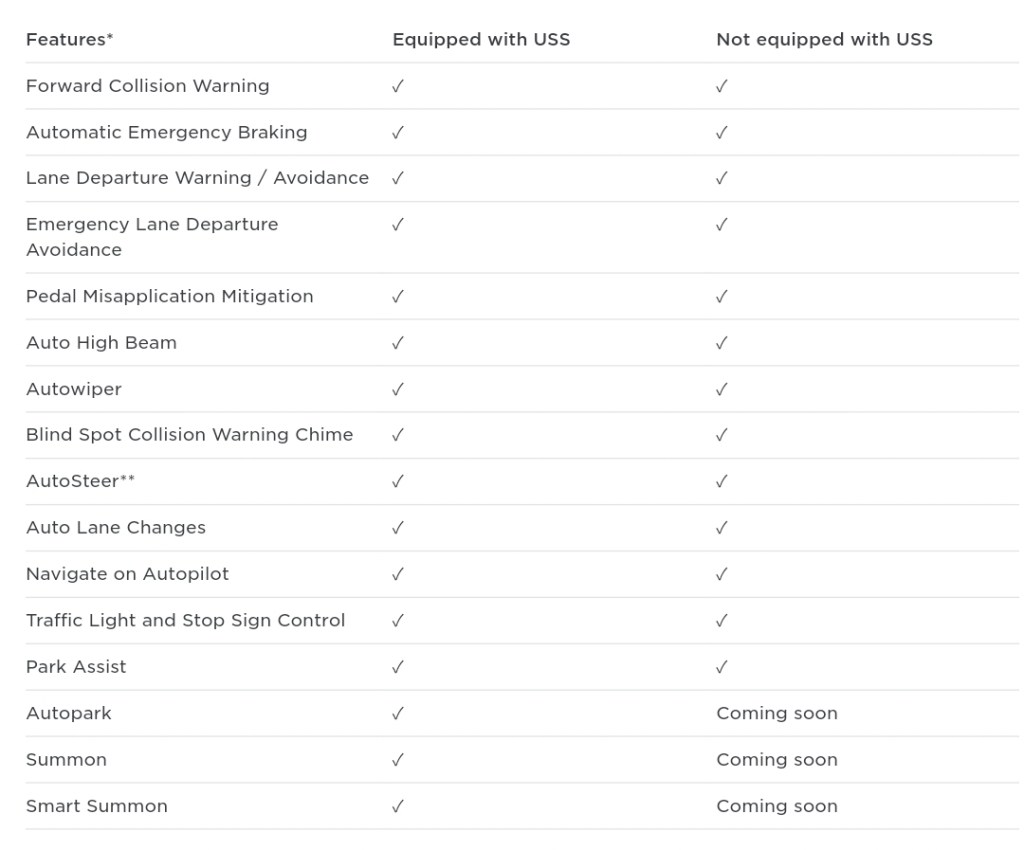
For a period of time during this transition, Tesla Vision vehicles that are not equipped with USS will be delivered with some features limited or inactive, including:
Autopark: automatically maneuvers into parallel or perpendicular parking spaces.
Summon: manually moves your vehicle forward or in reverse via the Tesla app.
Smart Summon: navigates your vehicle to your location or location of your choice via the Tesla app.
Once these features achieve performance parity to vehicles equipped with USS, vision-based vehicles will have these features restored via a series of over-the-air software updates. All other available Autopilot, Enhanced Autopilot and Full Self-Driving capability features will be active at delivery, depending on order configuration.
Given the incremental improvements already achieved with Tesla Vision, and our roadmap of future Autopilot improvements and abilities, we are confident that this is the best strategy for the future of Autopilot and the safety of our customers.
How do I know if my vehicle is equipped with ultrasonic sensors?Starting in early October 2022, all Model 3 and Model Y built for certain regions are no longer built with ultrasonic sensors and instead rely solely on Tesla Vision to provide Autopilot, Enhanced Autopilot, FSD capability and active safety features. Those regions include North America, Europe, Middle East, Taiwan and Korea.We are continuing this rollout with Model 3 and Model Y, globally, followed by Model S and Model X.If you have taken delivery of your vehicle and are curious if your vehicle is equipped with USS, the 12 sensors can be found on the front and rear bumpers of your vehicle.
Does the transition to Tesla Vision without ultrasonic sensors affect Model 3 and Model Y safety ratings for vehicles delivered on or after October 2022?No. The transition does not affect crash safety ratings. Vehicles equipped with Tesla Vision retain the same crash safety ratings as vehicles equipped with vision + radar + USS.
Will vehicles equipped with ultrasonic sensors have their functionality removed?At this time, we do not plan to remove the functionality of ultrasonic sensors in our existing fleet.
Does the transition to Tesla Vision affect the availability of some features on vehicles delivered on or after October 2022?For a period of time during this transition, Tesla Vision vehicles that are not equipped with USS will be delivered with some features temporarily limited or inactive, which includes the features outlined in the table below.
*Features listed are reflective of availability in North America. Features vary based on region and purchased Autopilot package.
**Autosteer maintains its 85 mph top speed, which is the same as Tesla Vision vehicles equipped with USS.
Once these features achieve performance parity to today’s vehicles, they will be restored via a series of over-the-air software updates.
Au cours des 20 années écoulées depuis la création de Tesla à San Carlos, en Californie, nous sommes passés d’une start-up de longue date au plus grand employeur manufacturier de l’État et au premier constructeur mondial de véhicules électriques .
Notre croissance exponentielle a été rendue possible grâce au travail acharné de l’équipe Tesla, à la fidélité de nos clients et au leadership en matière de politique climatique en Californie. Notre impact sur le Golden State ne se mesure pas seulement par nos réalisations environnementales, mais également par la croissance économique positive que nous avons pu partager avec l’État de Californie et ses habitants.
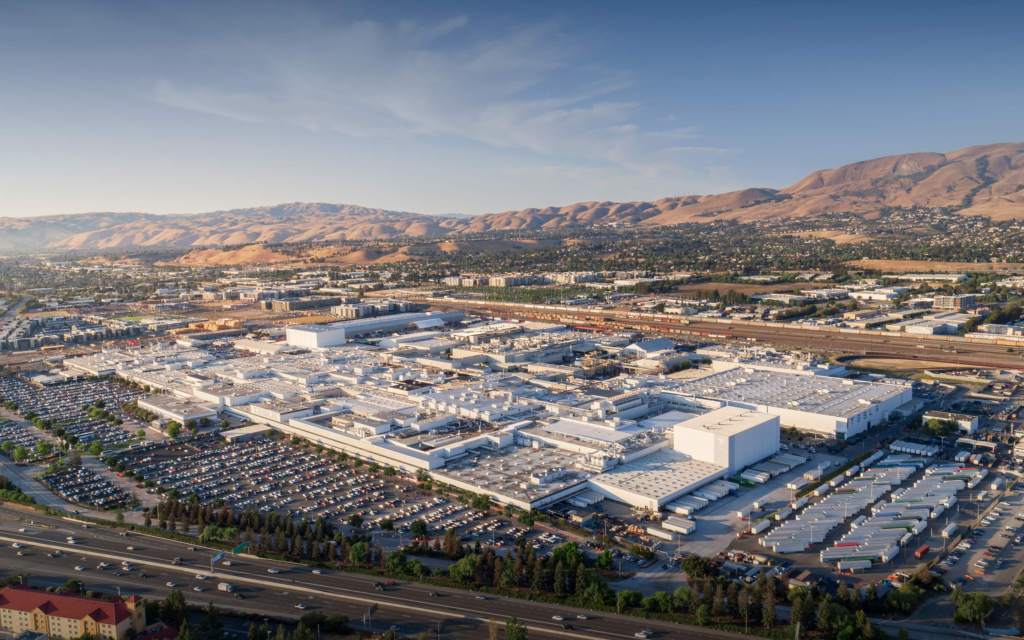
L’empreinte de Tesla en Californie comprend la production Megapack et le moulage de véhicules à Lathrop, l’ingénierie matérielle et logicielle à Palo Alto, la fabrication de véhicules et de batteries à Fremont, le développement et les tests de batteries à San Diego et la conception de véhicules à Hawthorne.
Ces efforts ont un impact important sur l’emploi, les salaires, le produit brut de l’État et l’assiette fiscale de la Californie.
Au cours de la dernière décennie, de nombreux emplois manufacturiers ont été exportés hors des États-Unis et les chaînes d’approvisionnement internationales ont été perturbées. Pourtant, Tesla a défié les tendances nationales en augmentant l’emploi et la production au niveau national. Les emplois soutenus par Tesla en Californie ont augmenté de 40 % entre 2018 et 2021, et les salaires en 2021 ont dépassé de 50 % la moyenne de l’État, offrant ainsi la rémunération la plus élevée de nos secteurs.
Une récente évaluation de l’impact économique menée par IHS Markit indique que les impacts économiques de Tesla en Californie comprennent :
Les emplois californiens (directs et indirects) soutenus par Tesla ont dépassé les 80 000 en 2021. Plus de 43 000 d’entre eux provenaient de 1,6 milliard de dollars de dépenses auprès des fournisseurs californiens.
Pour 100 emplois directs chez Tesla, 50 supplémentaires étaient soutenus dans la chaîne d’approvisionnement et 68 par l’activité de suivi des consommateurs.
De 2018 à 2021, Tesla a payé en moyenne 1 milliard de dollars d’impôts fédéraux, étatiques et locaux par an, avec environ 400 millions de dollars destinés aux impôts étatiques et locaux en 2021.
La contribution moyenne de Tesla au produit brut de l’État (GSP) a augmenté de 42 % entre 2018 et 2021, tandis que le SPG de l’État a augmenté de 16 %.
Les salaires des emplois Tesla et connectés à Tesla ont généré 16,6 milliards de dollars d’activité économique, soit 44,4 millions de dollars injectés chaque jour dans l’économie californienne.
En 2022, nous avons atteint 47 000 employés (emplois directs) en Californie, et notre empreinte de production a continué d’augmenter alors que notre 2 millionième véhicule est sorti des chaînes de Fremont. Depuis 2016, nous avons investi plus de 5 milliards de dollars dans nos installations. Nous sommes convaincus que ces tendances se poursuivront et que 2023 sera une année encore plus importante pour Tesla en Californie.
Évolution des performances des voitures électriques
L’Histoire du véhicule électrique en détails
La toute première voiture électrique date de 1834. Le moteur à explosion, plus complexe, a vu son émergence plus tard, en 1861. La première commercialisation d’un véhicule électrique remonte à 1850. Mais ces premiers modèles n’utilisaient pas de batterie électrique rechargeable : il faudra attendre pour cela 1852 et l’invention de la batterie rechargeable au plomb acide par Gaston Planté puis les travaux de Camille Faure, qui permettront à la voiture électrique d’avoir un véritable succès.
La « Jamais Contente » de Camille Jenatzy bat le record de vitesse en 1899 en dépassant les 100 km/h, et en 1900, une flotte de taxis électriques sillonne les rues de New-York. À l’époque, 38 % du marché automobile américain est capté par les véhicules électriques. Faciles à démarrer, ne laissant pas derrière elles un nuage irrespirable de fumée noire, ces voitures sont bien supérieures aux voitures thermiques de l’époque.
Qui dit voiture électrique dit point de recharge… sauf qu’à l’époque, on parle de colonne de charge pour automobile électrique. Le modèle prévoit déjà une intégration élégante dans le cadre urbain avec son format proche des boîtes aux lettres. Pour recharger ses accumulateurs, l’utilisateur doit mettre un jeton dans le compteur, fermer les coupe-circuits intérieurs, l’interrupteur bipolaire et choisir avec le commutateur du rhéostat l’intensité de charge (de 25 à 80 A) à fournir à la batterie.
Évolution des performances des voitures électriques
L’apparition en 1908 de la Ford T change la donne. Malgré l’invention en 1910 par Edison de la batterie Fer-Nickel, la voiture électrique cède face aux innovations de Ford : la production à la chaine abaisse les coûts de production et le démarreur électrique de Charles Kettering augmente considérablement le confort de véhicules thermiques.
Dans les années 1920, le thermique bon marché, meilleur en autonomie et en poids, supplante l’électrique.
C’est en 1973 que l’on s’intéresse à nouveau à la propulsion électrique : suite au choc pétrolier, l’importance d’une alternative au pétrole accompagnée d’une prise de conscience écologique donnent un nouveau souffle au développement du véhicule électrique. Des prototypes sont créés et commercialisés, dont la CitiCar en 1974 aux États Unis, qui atteint les 48 km/h et les 64 km d’autonomie. Cependant le prix du pétrole retombe et les ventes de véhicules électriques ne décollent pas.
Des actions politiques prennent place dans le monde, dont l’« Electric and Hybrid Vehicle Research, Development, and Demonstration Act », adopté par le Congrès américain en 1976, afin de pousser la recherche à développer de nouvelles batteries et de nouvelles voitures électriques.
En 1990, un grand pas est franchi avec la mise en place en Californie du Zero Emission Vehicle (ZEV) qui impose aux grands constructeurs américains de réaliser au moins 2% de leurs ventes avec des véhicules zéro émission en 1998. Les 2% du ZEV passe à 5% en 2001 et 10% en 2003. D’autres régions suivent le même mouvement.
Il faudra attendre le début des années 2010 pour que le véhicule électrique commence à s’installer au sein des gammes des constructeurs automobiles, notamment en Europe. Les principales marques automobiles comptent aujourd’hui plusieurs modèles du genre dans leur gamme. Les immatriculations augmentent, tout comme le nombre de points de recharge. Le plan « Fit for 55 » de la Commission Européenne fixe comme objectif aux États membres la fin de vente des véhicules thermiques en 2035. En parallèle se développent des deux-roues motorisés électriques, des utilitaires légers électriques et même des poids-lourds et bus électriques.
 Tesla
Tesla 